INGREDIENT GUIDE
Hyaluronic Acid
Biology, molecular weight, forms & scientific research
Hyaluronic acid, also called hyaluronan, is a naturally occurring glycosaminoglycan: a long carbohydrate polymer found in the spaces around cells and in fluids including those of joints and eyes. Its interaction with water helps explain its physical properties, while molecular size influences how it behaves in tissues and formulations. It is not an exfoliating acid, despite its name.
Understanding hyaluronic acid benefits means asking where the ingredient is acting. The polymer your body makes, a moisturiser applied to skin, a swallowed supplement and a medical injection involve different exposures and evidence. Research on one cannot automatically establish what another will do. This guide examines hyaluronic acid for skin, joint biology, production and human studies, with particular attention to molecular weight and the difference between a published finding and an authorised commercial claim.

Hyaluronic Acid at a glance
In this article
01 · THE INGREDIENT
What Is Hyaluronic Acid?
Hyaluronic acid is a non-sulphated glycosaminoglycan, often abbreviated GAG. Its linear polysaccharide chain contains a repeating disaccharide: D-glucuronic acid alternating with N-acetyl-D-glucosamine.
Within the extracellular matrix, the material surrounding cells, it interacts with water, proteins and cell surfaces. Unlike collagen, it is not a structural protein. Research on HA structure and function explains why chemical identity and chain length both matter.
Glycolic and salicylic acids are used for exfoliation. HA is not an essential vitamin with an established daily dietary requirement.
02 · BIOLOGY
What Does Hyaluronic Acid Do in the Body?
The body’s own HA contributes to matrix organisation, water balance and the mechanical behaviour of tissues. Its hydrophilicity means an affinity for water; viscoelasticity describes material behaviour with both fluid-like and elastic characteristics.
Cells build it using hyaluronan synthases, HAS1, HAS2 and HAS3, at the cell membrane. Hyaluronidases, including HYAL1 and HYAL2, participate in turnover; oxidative processes can also fragment chains.
Interactions with receptors such as CD44 and RHAMM, also called HMMR, help connect the matrix with cell behaviour. These effects depend on tissue and biological context, as described in research on HA biology. Explaining endogenous hyaluronic acid benefits does not establish that consuming more produces those same effects.
03 · MOLECULAR WEIGHT
Why Hyaluronic Acid Molecular Weight Matters
Molecular weight describes chain mass. A kilodalton, kDa, is one thousand daltons; a megadalton, MDa, equals one thousand kDa.
High molecular weight hyaluronic acid generally forms more viscous solutions than shorter chains under comparable conditions. Low molecular weight hyaluronic acid can behave differently in diffusion and biological interactions. Very short fragments, or oligosaccharides, are another category; they should not be treated as equivalent to every product labelled “low molecular weight”.
Definitions vary between studies, so there is no universal marketing cut-off. Hyaluronic acid molecular weight must be considered alongside concentration, formulation, route and outcome.
|
Description |
What it tells you |
|---|---|
|
Average molecular mass |
A summary of chain sizes |
|
Molecular-weight distribution |
How widely those sizes vary |
|
Concentration |
How much polymer is present |
04 · SKIN
Hyaluronic Acid for Skin: Biology and Hydration
HA occurs in both the dermis and epidermis. Fibroblasts and keratinocytes contribute to its production within different skin compartments. Its relationship with water and surrounding matrix components is part of normal skin biology; ageing-related changes are more complicated than a uniform loss throughout every layer.
Topically, HA can act as a humectant and form a hydrated surface film. That is different from demonstrating delivery into the dermis or replacing the body’s own polymer. The stratum corneum, the outer skin barrier, matters when interpreting penetration claims.
Research into hyaluronic acid for skin should identify what was measured: surface hydration, water loss, elasticity or appearance. A review of topical formulations describes different preparations and study designs. Studies of hyaluronic acid and skin hydration do not prove tissue regeneration.
Generated gel illustration; appearance does not establish composition or clinical effects.
05 · JOINTS
Hyaluronic Acid in Joints and Synovial Fluid
In joints, HA is a component of synovial fluid and participates in its viscoelastic behaviour. Within cartilage, it also forms part of large matrix assemblies involving proteoglycans.
Changes in concentration, chain size and turnover occur in joint disease. However, describing these changes does not establish that swallowed polymer arrives intact in the joint or repairs cartilage.
Searches for hyaluronic acid for joints often mix three subjects: normal physiology, oral trials and intra-articular injections. They require separate interpretation.
NICE’s osteoarthritis guidance advises against offering intra-articular hyaluronan injections for osteoarthritis. Medical use and guideline recommendations are not interchangeable, and neither supplies evidence for a supplement promise.
|
Context |
Evidence needed |
|---|---|
|
Body’s own HA |
Physiology and tissue research |
|
Oral product |
Controlled ingestion studies |
|
Injection |
Medical trials and guidelines |
06 · PRODUCTION
How Is Hyaluronic Acid Produced?
Historically, manufacturers extracted HA from animal tissues, including rooster combs. Microbial fermentation offers another source: organisms build the polymer from nutrients in a controlled culture. Streptococcus zooepidemicus has been an important industrial producer; research also uses recombinant hosts such as Bacillus subtilis.
Production literature describes fermentation conditions that affect yield and chain size. Temperature, pH, oxygen supply and increasing broth viscosity make process control important.
After fermentation, downstream processing separates cells and removes impurities. Depending on the process, this can involve filtration, precipitation, purification and drying. The final specification must describe identity, purity and molecular-weight distribution.

Illustrative production setting, not a documented manufacturer or measured process.
07 · FORMS & TERMINOLOGY
Hyaluronic Acid, Hyaluronan and Sodium Hyaluronate
The names are related, but a label still needs interpretation.
|
Term |
Meaning |
|---|---|
|
Hyaluronic acid |
Widely used name for the polymer |
|
Hyaluronan |
Scientific term independent of its protonation state |
|
Sodium hyaluronate |
Its sodium salt, commonly used in formulations |
|
Hydrolysed HA |
Material whose chains have been shortened |
|
Cross-linked HA |
Chains connected to alter material behaviour |
Sodium hyaluronate is not automatically smaller, more effective or better absorbed than another preparation. Chain size and formulation need their own specifications. Cross-linked materials used in medical applications should not be equated with an ordinary food ingredient.
Hyaluronic acid powder describes a physical format, not a particular molecular weight.
08 · TOPICAL USE
Topical Hyaluronic Acid in Skincare
Serums, creams and moisturisers combine HA with other ingredients that influence hydration, texture and tolerability. A formula containing sodium hyaluronate may also contain glycerol, oils or film-forming agents. Its performance cannot be attributed to one ingredient without an appropriate comparison.
A 2011 controlled topical study enrolled 76 women and compared 0.1% preparations of different chain sizes with vehicle-treated areas over 60 days. Hydration and elasticity improved; wrinkle-depth improvements were reported for the 50 and 130 kDa groups. These are findings for those formulations and endpoints.
When assessing hyaluronic acid for skin, look for a control group, objective measurements and a relevant application period. Hyaluronic acid benefits reported for a tested cream do not establish equal performance for every serum sharing its ingredient name.
09 · ORAL FORMS
Oral Hyaluronic Acid and Supplement Forms
A hyaluronic acid supplement may be supplied as capsules, tablets, powder or a drink. The declared daily amount, polymer form and other ingredients are more informative than the format alone. Hyaluronic acid powder is not inherently more concentrated in active ingredient than every capsule product.
Digestion complicates the picture. In 2023 labelled-polymer research, mice showed extensive gastrointestinal degradation involving gut microbiota and very low systemic bioavailability, approximately 0.2%. This is animal evidence, not a measured absorption percentage for humans.
Proposed mechanisms include effects of breakdown products and intestinal signalling. These remain different from proof that intact swallowed HA travels directly to skin or joints. For oral hyaluronic acid, human outcomes and mechanistic explanations should be assessed separately; a plausible pathway does not substitute for a controlled trial
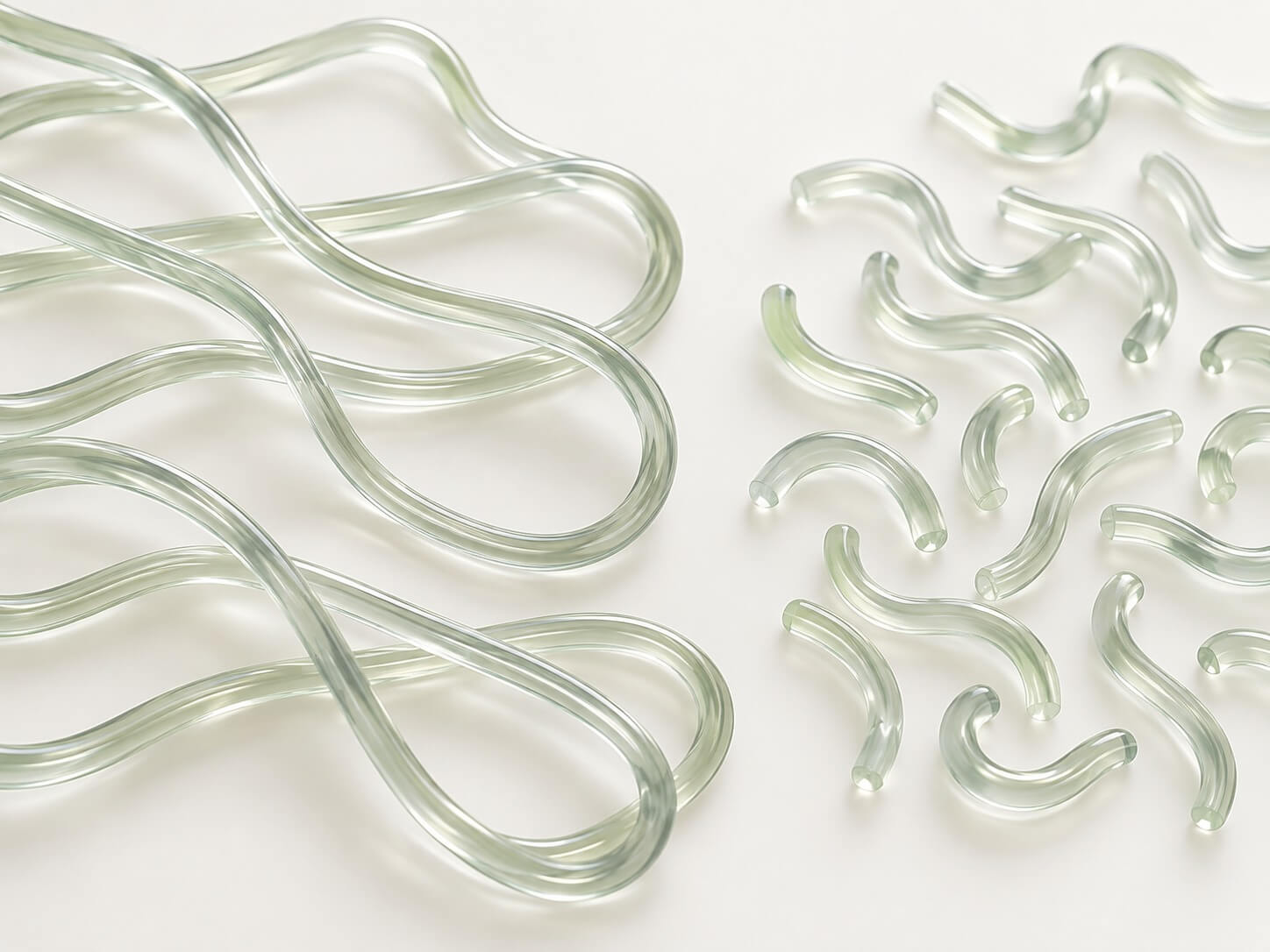
Illustrative chain-length concept; not to scale and not a chemical structure.
10 · HUMAN RESEARCH
What Has Human Research Investigated?
Oral skin outcomes
When assessing hyaluronic acid for skin, look for a control group, objective measurements and a relevant application period. Hyaluronic acid benefits reported for a tested cream do not establish equal performance for every serum sharing its ingredient name.
A subsequent 150-person trial tested 1.8 MDa sodium hyaluronate at 60 or 120 mg daily for 12 weeks against placebo. It reported improvements in several skin measurements. Manufacturer funding, employee authors, a restricted skin-type population and multiple outcomes without multiplicity correction limit interpretation. Trial doses are not personal recommendations.
Oral joint outcomes
A 2024 systematic review covered 11 studies and 597 participants, mostly with osteoarthritis. Nine studies used combinations with other ingredients. Although improvements were reported, attribution to HA alone is difficult. Evidence concerning hyaluronic acid for joints therefore cannot justify cartilage-repair claims or replacement of clinical care.
Keep the routes separate
Topical studies assess applied formulations; injection studies assess invasive medical products. Neither resolves whether a particular hyaluronic acid supplement works. Independent replication and longer follow-up remain valuable.
11 · UNDERSTANDING BENEFITS
What Do “Hyaluronic Acid Benefits” Searches Mean?
Hyaluronic acid benefits can refer to several different questions.
Endogenous biology: the body’s own polymer participates in water balance, matrix organisation and tissue mechanics.
Topical cosmetics: controlled research can assess hydration and appearance for a specific applied formula.
Oral supplements: trials investigate skin measurements or joint symptoms after ingestion; formulations and study quality vary.
Medical applications: injections and fillers have different exposures, uses and risks. Their evidence does not transfer to consumer creams or drinks.
Claims to reverse ageing, rebuild cartilage or replace all lost HA go beyond these distinctions.
12 · QUALITY
What Defines Hyaluronic Acid Ingredient Quality?
A useful specification identifies the polymer, source, amount, molecular-weight distribution and purity. Traceability connects the material with its supplier and batch testing. Microbiological quality and residual manufacturing impurities matter alongside chemical identity.
Specialised medical applications have additional requirements, including sterility or control of endotoxins and residual proteins. A cosmetic or food-grade ingredient should not be assumed suitable for injection. Bioprocess research discusses the importance of recovery and purification.
For a hyaluronic acid supplement, compare the declared daily amount with the preparation actually studied. For a cosmetic, ingredient presence alone does not reveal concentration or demonstrate finished-product performance. High molecular weight hyaluronic acid is not a universal quality winner; neither is the lowest available chain size.
13 · CLAIMS & REGULATION
Scientific Research Is Not the Same as an Authorised Health Claim
Food supplements and cosmetics follow different claim rules. A scientific paper does not itself authorise an advertising statement.
EFSA’s assessments of joint maintenance and protection against skin dehydration did not establish the required cause-and-effect relationships for the proposed food claims. The EU register and GB register must be checked for the applicable wording and status. The relevant HA entries checked for this guide are non-authorised.
Cosmetic claims instead require adequate, verifiable support under EU common criteria and corresponding GB rules. Ingredient research must not exaggerate what the finished cosmetic can demonstrate. Medical applications require their own evidence and regulatory assessment.
14 · SAFETY & LIMITATIONS
Safety and Important Limitations
Topical use
HA-containing cosmetics are often well tolerated, but the complete formula matters. Fragrance, preservatives or other ingredients can contribute to irritation. Stop using a product that causes a reaction and seek appropriate advice if symptoms persist.
Oral use
Norway’s VKM safety assessment found reassuring evidence for the amounts and populations assessed, but could not establish safety beyond 12 months or rule out rare harms. This is not a universal dose recommendation.
Pregnancy, breastfeeding and medically complex populations are underrepresented in trials. Discuss supplementation with a clinician when those circumstances apply; absence of reported harm is not proof of safety for every person.
Injectable use
Injections introduce distinct procedural risks, including infection and tissue injury. The fact that HA occurs naturally does not make every product or route risk-free.
15 · COMMON MISUNDERSTANDINGS
Common Hyaluronic Acid Misunderstandings
“All acid ingredients exfoliate.” HA is a polysaccharide, not an AHA or BHA exfoliant.
“Smaller always works better.” Low molecular weight hyaluronic acid changes material behaviour; effectiveness still depends on the formulation and use.
“A serum replaces deep dermal HA.” Surface hydration does not establish replenishment of the body’s own tissue matrix.
“Injection results prove capsules work.” Oral, topical and injected routes involve different exposures and evidence.
“All HA is vegan.” Animal extraction and microbial production both exist. Verify the specific ingredient, processing inputs and the complete product.
“The highest percentage guarantees the best result.” Concentration matters, but so do chain distribution, other ingredients and the tested outcome.
16 / FAQ & key takeaways
Hyaluronic Acid FAQ
THE ESSENTIAL POINT
Key takeaweys
Hyaluronic acid benefits should always be tied to a route and a measured outcome. The polymer’s normal role in tissues is well established, but it does not prove that any particular cream, capsule or drink reproduces those functions. Topical hydration, oral study findings and injection outcomes are separate evidence categories.
Molecular size helps explain how the ingredient behaves, but it is not a universal ranking of quality. Source, purity, concentration, chain distribution and the finished formulation matter together. Names such as sodium hyaluronate or “hydrolysed” provide information, not an automatic guarantee of superior absorption or effectiveness.
Human research offers useful findings and remaining questions. Read the comparator, population, duration, funding and actual endpoint before generalising. Scientific support and commercial claim permission also require separate checks. That distinction allows an educational article to discuss emerging evidence without presenting an unapproved food-health claim or promising that a product reverses ageing or repairs joints.
Hyaluronic Acid in the LR Product Range
LR’s current Austrian 5in1 information identifies HA in the Beauty Elixir and describes it as low-molecular-weight. This confirms ingredient context for that market; it does not establish an exact molecular-weight distribution or validate every marketing statement.
Check the current local label before quoting an amount or discussing another country’s version. General HA studies do not demonstrate the effects of LR’s complete multi-ingredient formula.
Where qualifying vitamins or minerals support authorised claims, those effects should be attributed to the relevant nutrients under their conditions of use. They must not be reassigned to HA.
Health information: This article is provided for general informational purposes and does not replace professional medical advice.